❧ Written Entry
Future of AI agent
The Dawn of the Agentic Era: The Future of AI Agents (2026-2030)
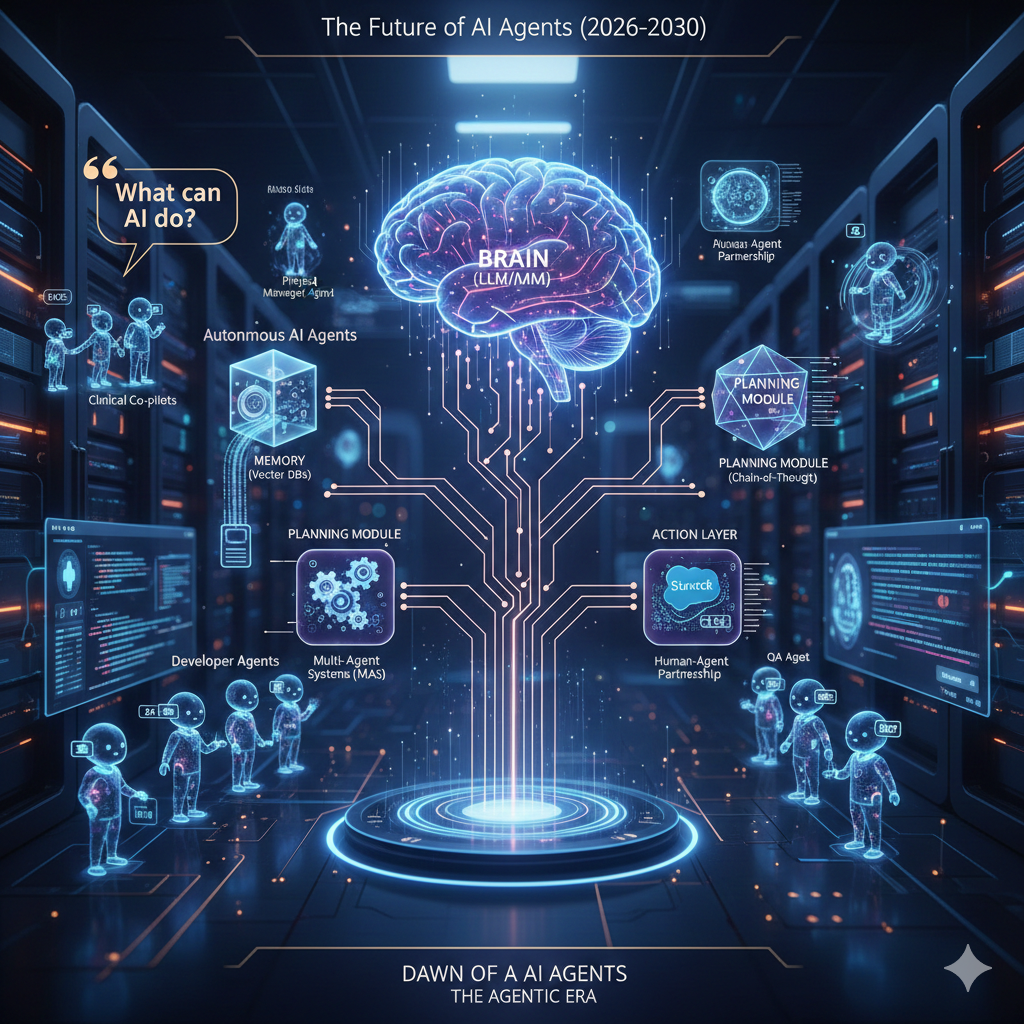
By 2026, the conversation around Artificial Intelligence has shifted from "What can AI say?" to "What can AI do?" We have moved past the era of simple chatbots into the age of Autonomous AI Agents—systems capable of reasoning, planning, and executing complex workflows with minimal human intervention.
1. Defining the Agentic Leap
Unlike standard LLMs (Large Language Models) that respond to prompts in isolation, an AI Agent is characterized by four core pillars:
- Autonomy: The ability to take independent action to reach a goal.
- Perception: Understanding the environment through multimodal inputs (text, vision, audio).
- Reasoning & Planning: Breaking down a complex goal (e.g., "Plan a marketing campaign") into actionable sub-tasks.
- Tool Use: The capacity to use external APIs, browse the web, and execute code.
"The transition from LLMs to AI Agents is the most significant shift in computing since the move from command-line interfaces to the Graphical User Interface (GUI)."
2. The Technical Architecture of the Future
Modern agentic systems are no longer single models but "Systems of Intelligence." The standard architecture now includes:
| Component | Function |
|---|---|
| Brain (LLM/LMM) | The core reasoning engine (e.g., GPT-5, Claude 4, Gemini 3). |
| Memory (RAG & Long-term) | Stores user preferences and past interactions using Vector Databases. |
| Planning Module | Uses Chain-of-Thought (CoT) to outline steps before execution. |
| Action Layer | Connectors to tools like Slack, GitHub, Salesforce, and Web Browsers. |
3. Key Trends Shaping 2026 and Beyond
A. The Rise of "Digital Assembly Lines"
Instead of one agent doing everything, we are seeing Multi-Agent Systems (MAS). Imagine a "Project Manager Agent" that delegates coding to a "Developer Agent," testing to a "QA Agent," and documentation to a "Writer Agent." This digital assembly line allows for 24/7 productivity with near-zero overhead.
B. Personal AI Sovereignty
Personal agents are becoming our "Digital Twins." These agents live on-device (Edge AI), ensuring privacy while managing our schedules, negotiating our bills, and even filtering our communications based on learned preferences.
C. The Model Context Protocol (MCP)
The industry has converged on standardized protocols that allow agents to "plug and play" into any data source. This has eliminated the "walled gardens" of 2024, making data interoperability the norm.
4. Industry Impact: A Vertical Analysis
- Healthcare: Agents act as "Clinical Co-pilots," monitoring patient vitals in real-time and adjusting treatment plans based on the latest medical literature.
- Finance: Autonomous agents handle high-frequency "Reasoned Trading," moving beyond simple algorithms to understand market sentiment and geopolitical shifts.
- Software Engineering: The role of the developer has shifted to System Architect. Agents now write 80% of the boilerplate code, while humans focus on logic and security audits.
5. Ethical Frontiers and Challenges
With great autonomy comes great risk. The "Agentic Future" faces three primary hurdles:
- The Alignment Problem: Ensuring an agent doesn't take "shortcuts" that are technically correct but ethically or practically disastrous.
- Economic Displacement: As agents take over entry-level cognitive tasks, the "Junior-to-Senior" pipeline in many industries must be redesigned.
- Security (Prompt Injection 2.0): Protecting agents from being "hijacked" by malicious external inputs that command them to leak sensitive data.
6. Conclusion: The Human-Agent Partnership
The future of AI is not about replacement; it is about augmentation. By 2030, a single human "Operator" will possess the productive capacity that previously required a department of fifty people. Our primary skill will shift from execution to intent-setting and curation.